
How Car Glass Oil Film Forms & The Complete Guide to Koch-Chemie Nano Glass Coating for Enhanced Rainy-Day Visibility
Misty windscreens and scattered lights in the rain could be due to glass oil film and water spots. This article explains how oil film forms, methods to remove it, and the principles, application process, and maintenance tips for Koch-Chemie Nano Glass Coating.
ByLETS GET WASH
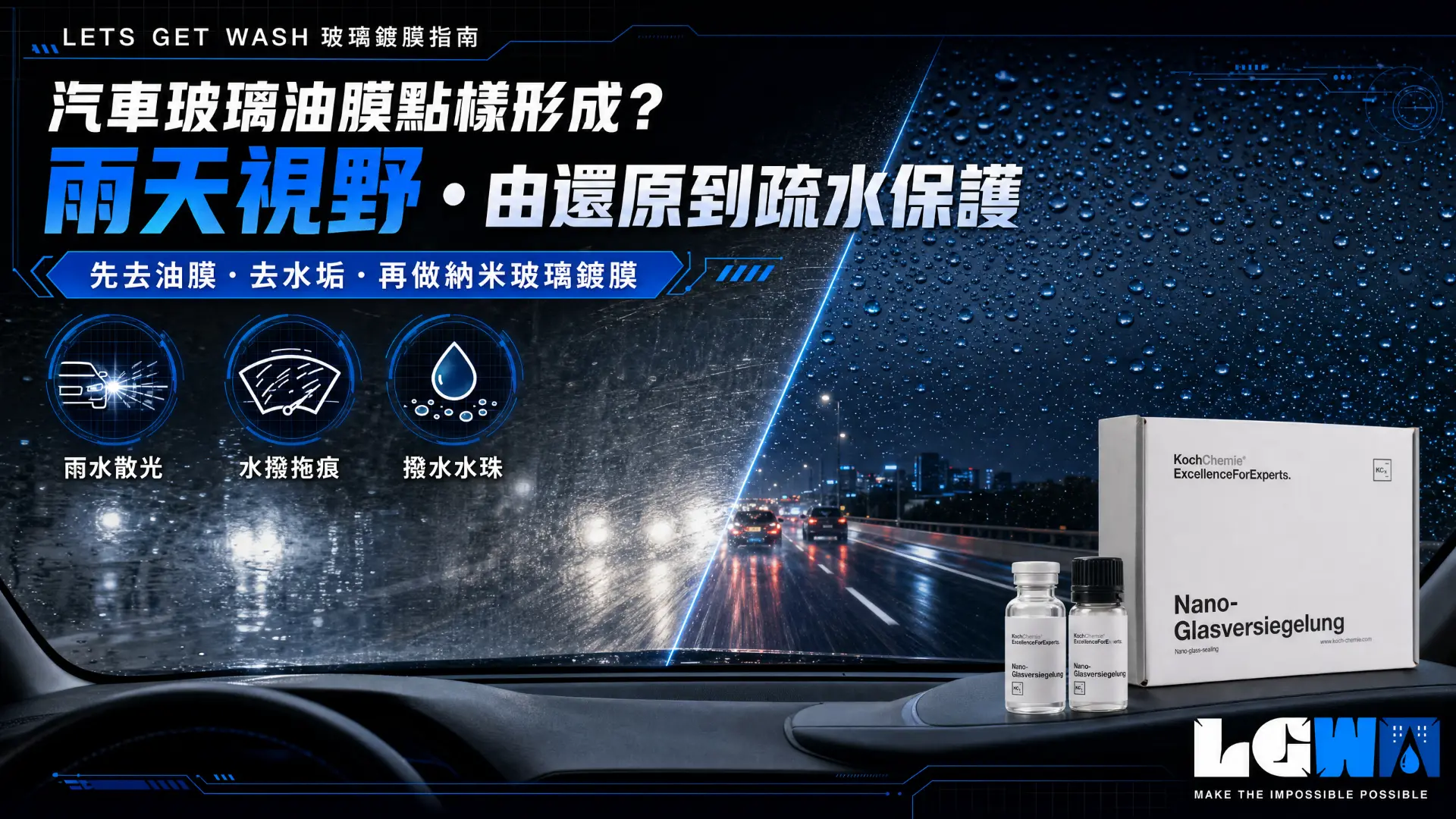
When driving in the rain, even with your wipers on, does your windscreen still appear hazy, lights scatter, and rainwater stubbornly cling in sheets? The issue might not just be old wipers; it could also be an accumulation of oil film, water spots, road grime, or microscopic corrosion layers on the glass surface. What we call 'glass oil film' isn't the glass itself 'producing oil', but rather a thin, mixed layer formed by the gradual adhesion of grease, road pollutants, exhaust particles, insect residue, rainwater, and cleaning product residues.
To genuinely improve rainy-day visibility, simply spraying screenwash might not be enough. A more comprehensive approach involves first removing oil film, water spots, and then polishing the glass to restore its clarity. Following this, apply Koch-Chemie Nano Glass Coating to create a hydrophobic surface, which reduces the adhesion of water droplets and dirt.
In Summary: Glass Oil Film is a Thin Layer of Accumulated Everyday Pollutants
'Oil film' is a convenient everyday term, but it doesn't necessarily originate solely from actual engine oil. During daily driving, your windscreen comes into contact with oily particles splashed from the road, exhaust fumes and soot, brake dust, tar components, insect remains, rainwater, car wash residues, and even microscopic marks left by wiper blades. Koch-Chemie's official glass cleaning product information also mentions that glass surfaces can accumulate oil, grease, insect remains, and other stubborn dirt.
When these substances gradually adhere due to sun exposure, rain, and insufficient daily cleaning, the glass surface loses its uniformity. This might not be obvious in dry weather, but as soon as it rains or at night with artificial lights, rainwater will be drawn into irregular streaks, and wipers will leave behind hazy smears.
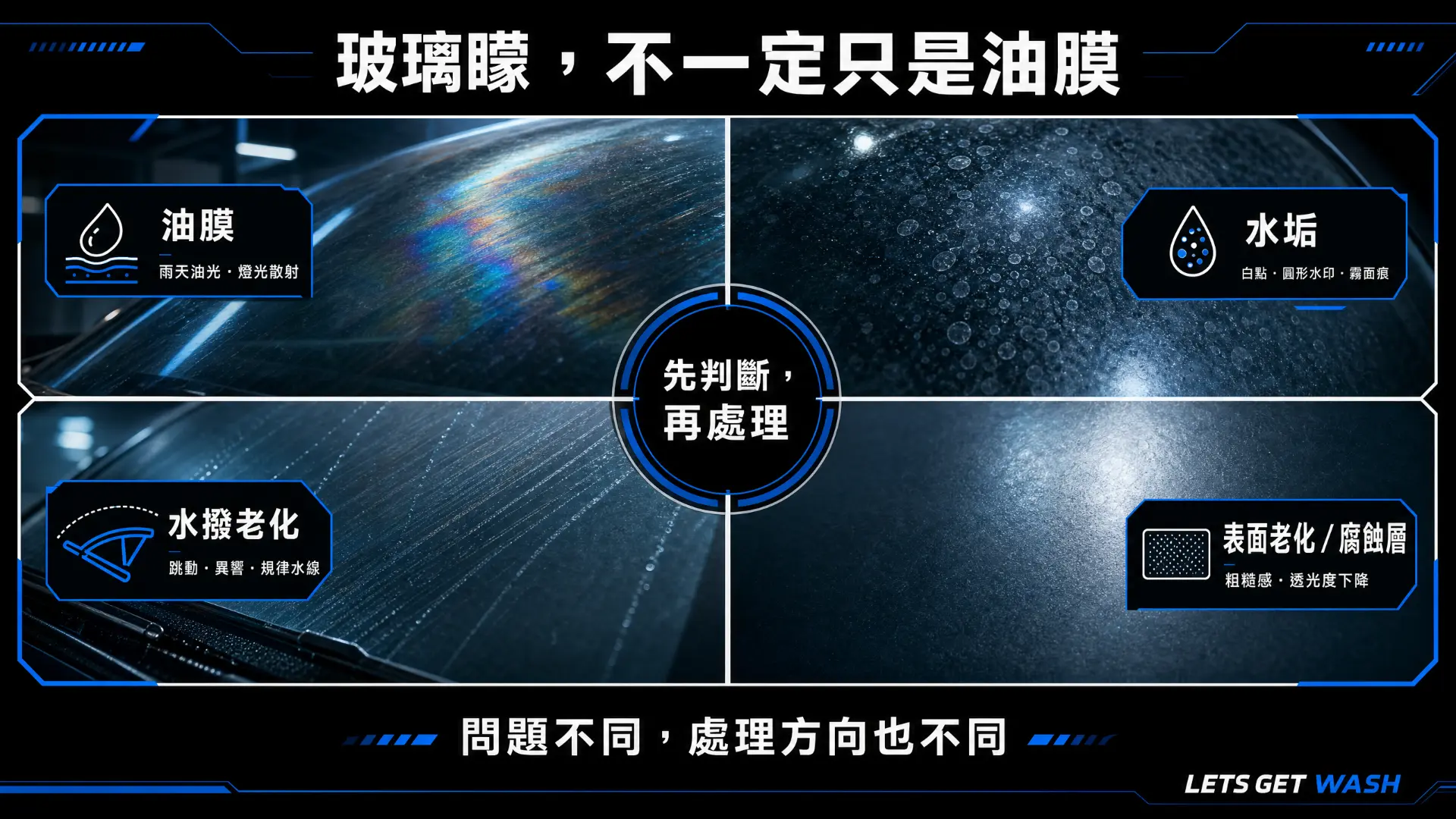 It's not always just oil film: The difference between oil film, water spots, worn wipers, and surface corrosion
| Glass Problem | Common Appearance or Sensation | Possible Causes | Most Suitable Treatment |
|---|---|---|---|
| Oil Film | Hazy in rain, oily sheen or streaks after wiping, scattered lights at night | Mixed adhesion of grease, road pollutants, soot, insect remains, and cleaning residues | Deep cleaning, oil film removal, polishing to restore if necessary |
| Water Spots | White spots, circular watermarks, or hazy marks after drying | Mineral residues from rainwater, car wash water, or spray drying | Water spot removal, prevent water from drying on glass for extended periods |
| Worn Wipers | Ineffective wiping, juddering, squeaking, leaving streaks | Aged, deformed, contaminated rubber blades, or uneven pressure | Inspect and replace wipers, simultaneously clean glass |
| Glass Ageing/Corrosion Layer | Reduced clarity, never truly clean despite washing, rough surface | Long-term sun exposure, pollutants, and changes in glass surface condition | Professional polishing and assessment for coating suitability |
| Interior Fogging or Film | Interior glass fogs up easily, noticeable glare at night | Interior volatile organic compounds, AC circulation, fingerprints, or inadequate interior cleaning | Use appropriate interior glass cleaning methods; do not use exterior hydrophobic coatings on the inside |
How Does Glass Oil Film Form? Five Common Sources in Hong Kong
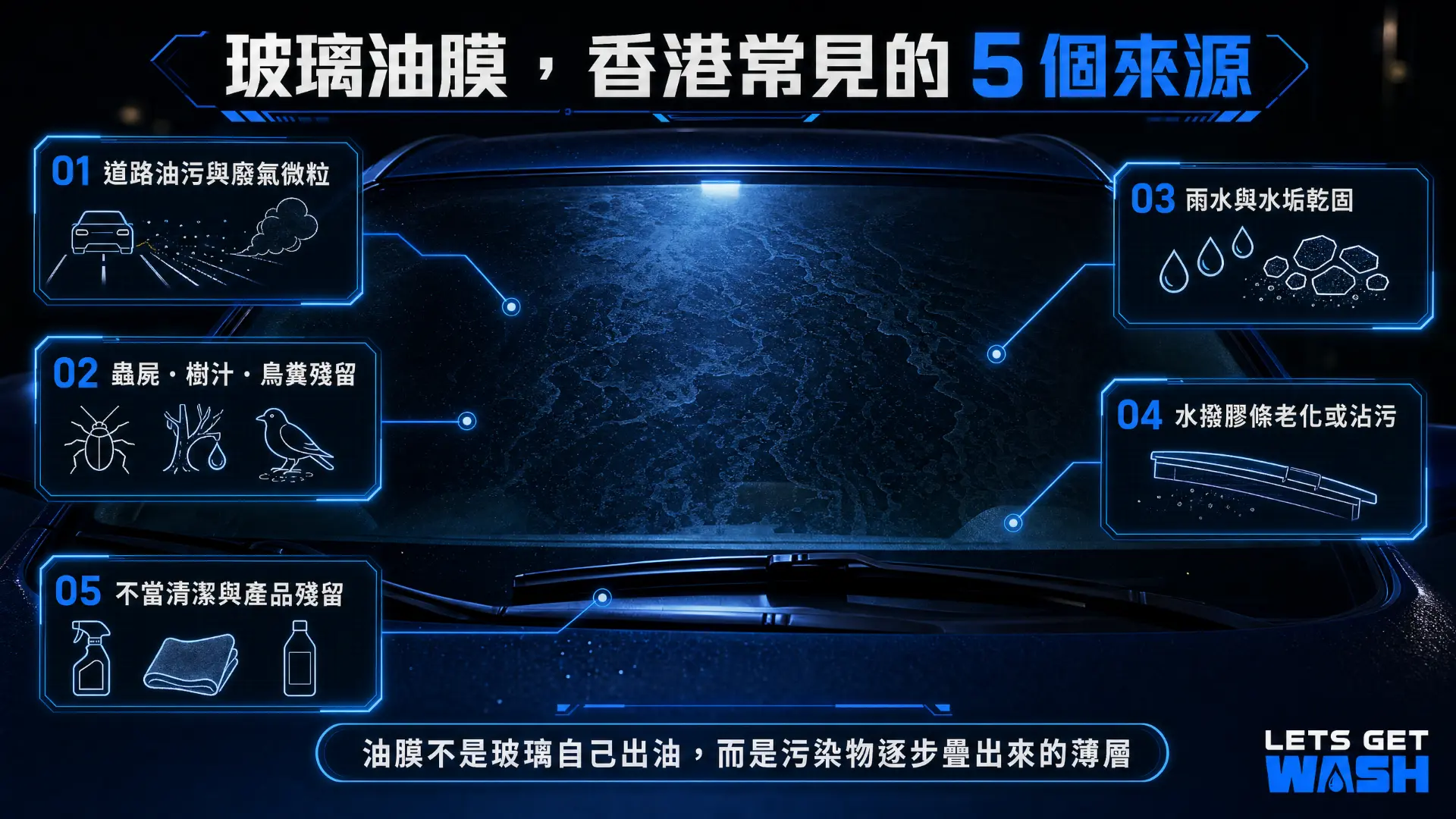 Five common sources of glass oil film in Hong Kong
1. Gradual Accumulation of Road Grime and Exhaust Particles
Hong Kong's urban areas have dense traffic, and roads themselves contain grease, dust, tyre wear particles, and various pollutants. In the rain, these splash onto the windscreen; in dry weather, they adhere as a thin layer of dust. Over time, the glass surface loses its smoothness, and rainwater begins to form irregular films and streaks.
2. Insect Remains, Tree Sap, Bird Droppings, and Organic Residues
After long-distance highway driving, rural excursions, or parking under trees, the front windscreen can easily accumulate insect remains, tree sap, or bird droppings. If not cleaned promptly, repeated exposure to sun and rain can turn these into more stubborn residues. Koch-Chemie Nano Glass Coating's official information states that its hydrophobic surface can reduce the adhesion of environmental dirt, insect remains, and ice, making subsequent cleaning easier.
3. Mixed Marks from Dried Rainwater and Water Spots
Rainwater is not pure. When parked outdoors, rainwater carries airborne particles onto the glass; if car wash water evaporates naturally, minerals in the water will also leave marks. When water spots mix with oily pollutants, the glass will appear 'not very dirty, but never quite clear'.
4. Mutual Influence Between Wiper Blades and Glass Surface
Wipers are designed to sweep water away, but they cannot eliminate oil film on the glass. If the rubber blade is aged, contaminated, or deformed, it's more likely to judder, squeak, or leave curved water marks when sweeping over an oily film. To improve rainy-day visibility, both the glass and the wipers should be checked.
5. Improper Cleaning and Product Residues
Spraying wax, paint sealants, oily cleaning products, or incompatible products onto the glass can create an uneven film. Fingerprints, volatile compounds from interior plastics, and using the wrong type of cloth can also make interior and exterior glass appear streaky after wiping.
How to Tell if Your Car Has Glass Oil Film? Four Self-Check Methods Without Special Tools
- Observe Water Droplets: When safely parked, observe how water behaves during rain or after spraying. If water doesn't uniformly bead up or flow off, but instead forms oily patches, or if wipers leave hazy streaks, you likely have oil film or water spots.
- Observe Nighttime Lights: If oncoming headlights noticeably scatter into a halo effect, and your interior glass is clean and wipers are functioning normally, it's worth inspecting the exterior glass surface.
- Observe Wiper Action: Juddering, squeaking, or regular water lines left after wiping. First, check if the rubber blade is aged or cracked, then check the glass for residues.
- Lightly Touch Glass Edges: Gently touch the edges of the cleaned and dried exterior glass with the back of your hand. If it feels uneven, rough, or sticky, it may require more intensive treatment than regular glass cleaning.
Safety Tip: Please only check the glass condition when your vehicle is safely parked. Never test while driving. Glass coatings can improve water repellency but cannot replace careful driving and proper use of wipers.
What's the Difference Between Oil Film Removal and Glass Coating? The Former Restores, The Latter Protects
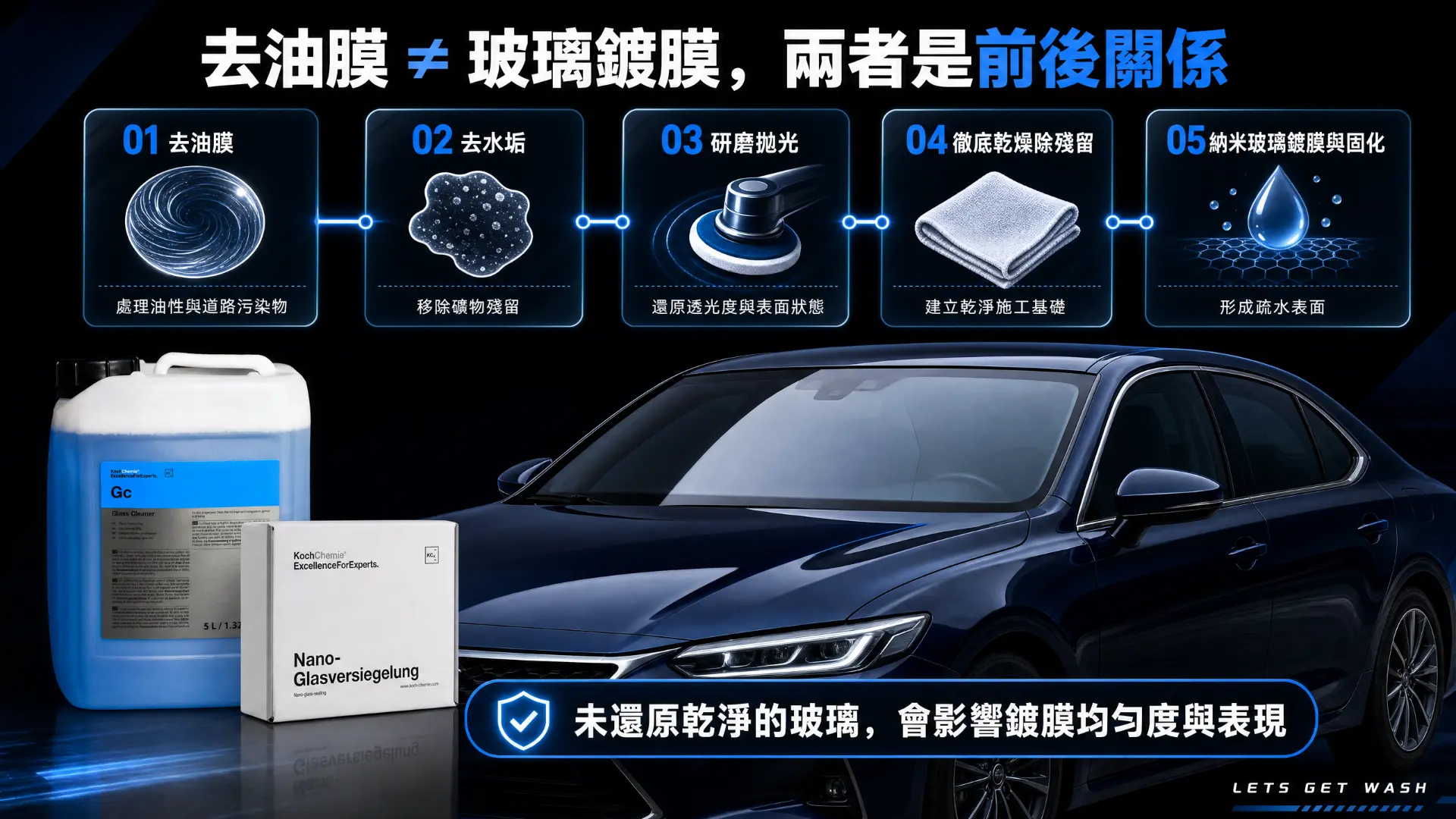 Five steps for oil film removal and glass coating: oil film removal, water spot removal, polishing, drying and residue removal, nano coating and curing
The goal of oil film removal, water spot removal, and polishing is to eliminate pollutants, residues, and conditions affecting clarity on the glass surface, returning the glass to a cleaner, smoother foundation for application. The goal of glass coating is to establish hydrophobic properties on this pre-treated surface, making it harder for rainwater and some dirt to adhere.
Koch-Chemie's official application recommendations for the Nano-Glasversiegelung Set are very clear: the windscreen must be thoroughly cleaned before coating. Stubborn dirt should be addressed first, and the glass surface should be cleaned and its upper corrosion layer removed with a polishing compound to create optimal conditions for chemical bonding.
| Process | Core Purpose | Risks if Not Done Properly |
|---|---|---|
| Oil Film Removal | Removes the mixed thin layer of oily and road pollutants | Rainy-day streaks and scattered light persist, poor coating adhesion |
| Water Spot Removal | Addresses mineral residues and dried watermarks | Glass still appears hazy, surface remains uneven |
| Polishing | Improves glass surface condition and clarity | Should not be arbitrarily skipped, nor over-applied; assess based on vehicle condition |
| Thorough Drying & Residue Removal | Creates clean application conditions for the coating | Moisture or residues may interfere with coating performance |
| Nano Glass Coating & Curing | Establishes a hydrophobic surface, enhances rainy-day water repellency and ease of cleaning | If exposed to water or dirt before curing is complete, the effect may be compromised |
What is Koch-Chemie Nano Glass Coating? It's Not Just Regular Glass Cleaner
Koch-Chemie's Nano-Glasversiegelung Set is a nano glass coating product. The manufacturer describes it as a reactive sealant that forms a hydrophobic nano-network on glass, mirror, and ceramic surfaces, stating that this surface is chemical-resistant and abrasion-resistant, reducing the adhesion of environmental dirt, insect remains, etc. For the front windscreen, the most noticeable effect is that rainwater more easily forms beads and is carried away by airflow when driving.
However, glass coating should not be misunderstood as 'completely eliminating the need for wipers in the rain'. Koch-Chemie officially states that at approximately 80 km/h or above, raindrops can be carried away by airflow due to the hydrophobic effect; LETS GET WASH service FAQ, based on actual service experience, suggests that at approximately 60 km/h or above, water droplets tend to fly off automatically, but wipers are still recommended for low-speed city driving. These figures are not guarantees but reflect that rain intensity, vehicle type, glass angle, wind direction, coating condition, and speed all influence actual performance.
'Nano' does not mean there's a thick, visible layer on the glass, but rather that the product forms a microscopic network with hydrophobic properties on the surface (often referred to as the lotus effect). Koch-Chemie also advises that glass coating should be applied on a completely dry surface, at ambient temperatures of 10 to 30°C, avoiding direct sunlight, and the surface should be protected from water and dirt until curing is complete – indicating that it's not a casual DIY spray application under direct sun.
How Does LETS GET WASH Perform Glass Coating Services?
LETS GET WASH's glass coating service (which includes oil film removal) lists three core steps on its service page: First, glass oil film and water spot removal; second, polishing to restore clarity; third, applying the hydrophobic coating and curing it. The application time is approximately 2 hours, subject to actual vehicle condition; the pricing page currently shows 888 LGPoint (approx. HK$888). Information may be updated with service arrangements, so please confirm with the website and in-store before booking.
| Application Stage | What Problem It Solves | What the Car Owner Can Expect |
|---|---|---|
| Glass Oil Film & Water Spot Removal | Removes surface pollutants and mineral residues | Reduces rainy-day water film, oily sheen, and stubborn residues |
| Polishing to Restore Clarity | Improves glass surface condition | Glass returns to a better foundation for coating, visually clearer |
| Applying Hydrophobic Coating & Curing | Establishes water-repellent performance on clean glass | Rainwater more easily forms beads, easier daily cleaning |
| Vehicle Handover & Maintenance Advice | Explains wiper care, cleaning, and usage tips | Helps maintain effectiveness, avoids products that weaken water repellency |
If the windscreen has deep scratches, stone chips, cracks, or severe surface damage, glass coating cannot replace repair or replacement. Safety and structural issues should be prioritised.
How to Maintain Your Glass After Coating?
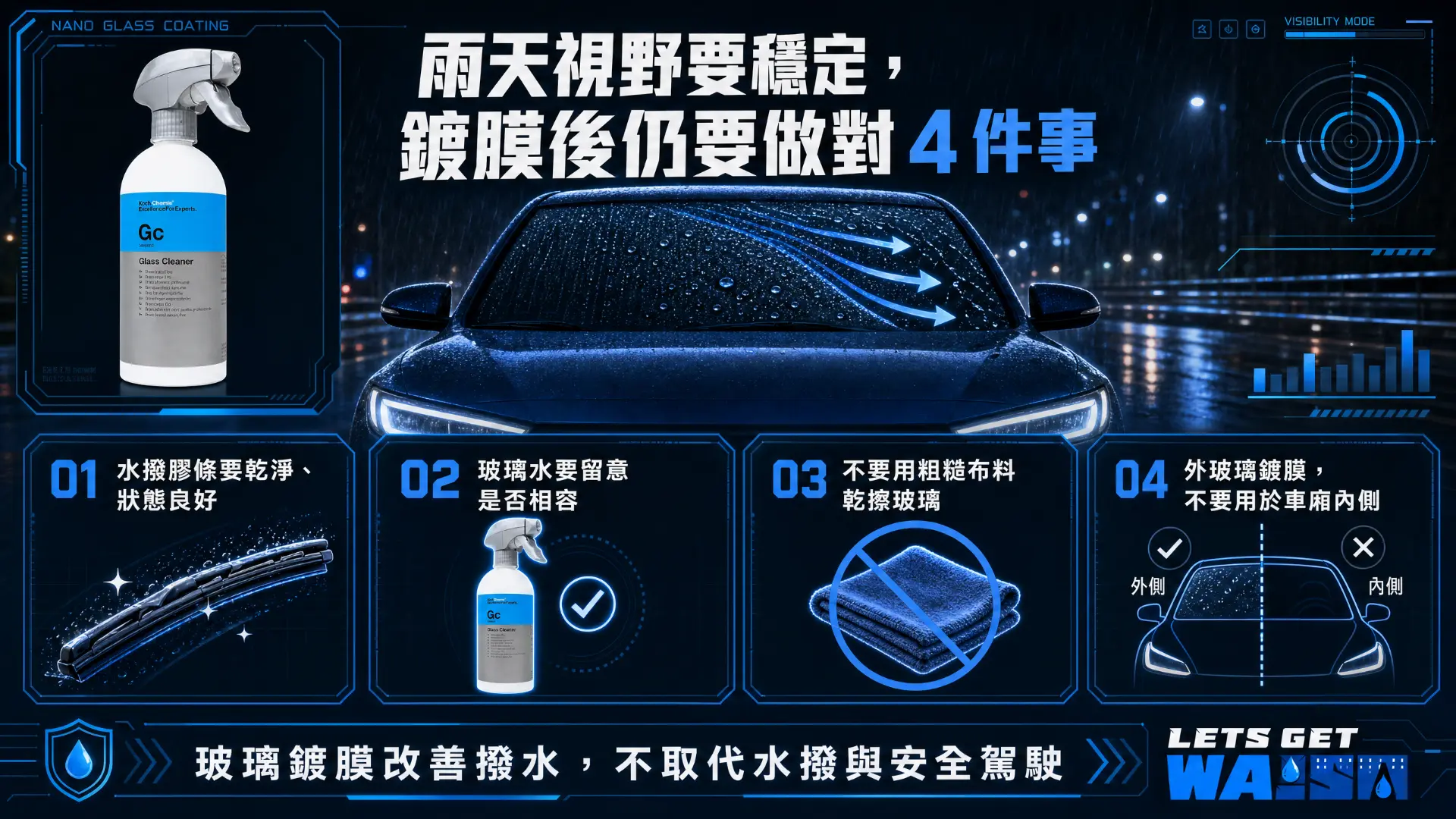 Four essential things to do after coating
- Keep Wiper Blades Clean and in Good Condition: The coating helps water beads run off, but wipers are still crucial for safety at low speeds, when stopped, in traffic, and during heavy rain; replace blades if they harden, crack, or judder.
- Check Screenwash Compatibility: Koch-Chemie officially warns that strong hydrophilic screenwash additives may reduce the hydrophobic effect. If unsure, consult the application team first.
- Avoid Dry Wiping Glass with Coarse Cloths: Dry wiping dust and grit can leave microscopic marks, affecting the coating's surface integrity.
- Exterior Glass Coating Should Not Be Used on Interior: The manufacturer states that the hydrophobic effect may increase the tendency for interior fogging; interior glass should be kept clean and free of oily residues using appropriate cleaning methods.
Glass Oil Film, Glass Coating, and Safe Driving: Three Realities
Firstly, glass coating is not night vision. Heavy rain at night, glare, oncoming high beams, dense fog, and fatigued driving will all affect visibility. Secondly, wipers remain essential equipment and should still be used as needed for low-speed city driving. Thirdly, coating cannot repair glass cracks; if there are stone chips or long cracks, address the glass safety issues first.
Frequently Asked Questions
Can I remove glass oil film myself with screenwash?
Minor dirt might improve, but if oil film, water spots, and old residues have accumulated, everyday screenwash alone may not be sufficient. For nano glass coating application, a more comprehensive surface cleaning, polishing, and drying process is still needed to ensure proper coating adhesion.
If I have glass coating, do I completely avoid using wipers in the rain?
No. At approximately 60 km/h or above, water droplets will more easily fly off automatically, but wipers are still recommended for low-speed city driving. Actual effects are influenced by rain intensity, speed, vehicle type, glass angle, and coating condition. Safe driving always takes priority.
How long does Koch-Chemie Nano Glass Coating last?
Koch-Chemie's official product page claims durability of up to one year or 20,000 kilometres; LETS GET WASH's service page, based on in-store service experience, lists generally around 3 to 12 months, depending on parking environment and washing frequency. Both are reference figures, not fixed guarantees.
Can glass coating fix wiper juddering?
If juddering is caused by glass oil film, dirt, or an uneven surface, thorough oil film removal and glass treatment may help; however, if the rubber blade is aged, deformed, or there's an issue with wiper arm pressure, the wipers still need inspection or replacement.
Can nano glass coating be applied to interior car glass?
Not recommended. The manufacturer states that nano glass coating is not suitable for interior vehicle glass, as the hydrophobic effect may increase the tendency for interior fogging.
Which Cars Particularly Benefit from Glass Oil Film Removal and Coating?
Car owners who frequently drive at night, often on highways, experience scattered lights in the rain, notice streaks after wiping, park outdoors long-term, or value rainy-day visibility and efficient daily maintenance, should consider a glass condition inspection. If there are cracks, deep scratches, or severe damage, repair or replacement should be prioritised.
Conclusion: To See Clearly in the Rain, the First Step is to Properly Treat the Glass Surface
Glass oil film is the result of gradual accumulation from daily driving, weather, pollutants, water spots, and cleaning habits. To improve it, the solution isn't just changing wipers or casually spraying a product, but first distinguishing between oil film, water spots, glass ageing, and wiper issues. Then, follow a comprehensive process: oil film removal, water spot removal, polishing to restore clarity, followed by the hydrophobic protection of Koch-Chemie Nano Glass Coating.
If you've noticed your front windscreen is hazy in the rain, wipers leave streaks, or nighttime lights appear dazzling, we welcome you to book a vehicle inspection. Please mention any issues like wiper juddering, water spots, oil film, night glare, or glass damage when booking, so our team can provide tailored advice based on your actual needs.