
Will AI Car Washes Scratch Your Paintwork? Understanding Robotic Car Wash Principles, Risks & Considerations
AI robotic car washes don't equate to 'touchless' or 'absolutely no scratches'. The true determinants of paintwork risk are whether grit is thoroughly removed, if tools are clean, contact pressure is controlled, and if there's a final manual inspection.
ByLETS GET WASH
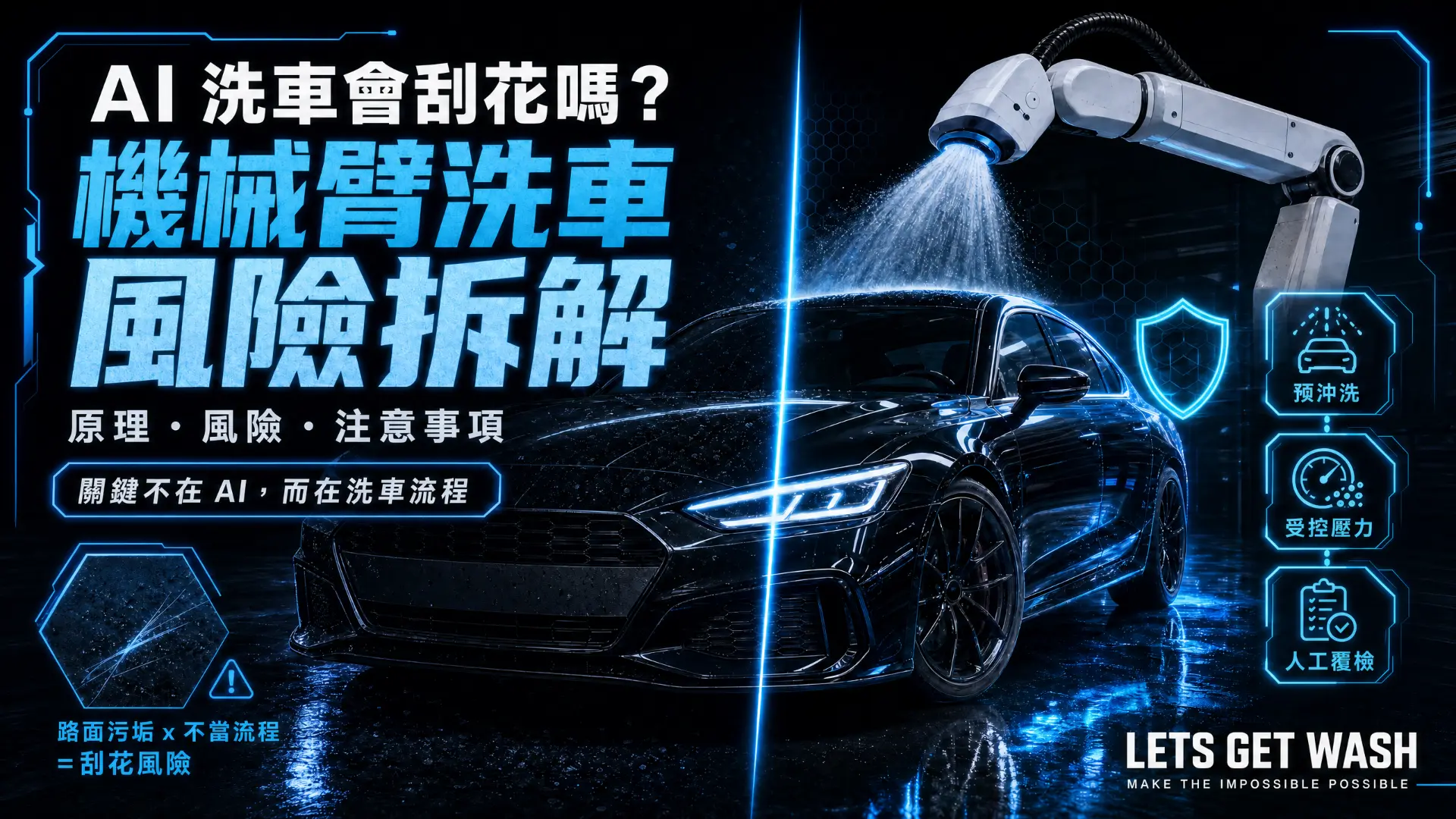
When many car owners first hear "AI car wash" or "robotic car wash", the same question often comes to mind: Will the robotic arm hit the car body? Will it leave scratches during washing? Owners of dark-coloured cars, newly coated vehicles, or those with PPF paint protection film are often particularly sensitive to fine lines on the paint surface.
This concern is valid, but the answer shouldn't be a simple 'yes' or 'no'. Whether car paint develops wash-induced swirl marks isn't solely determined by 'manual' or 'robotic arm' methods, but by the entire car wash process. Wiping a car body directly when it's covered in grit, brake dust, or tar particles, even with light pressure, can create micro-abrasions. Conversely, if loose contaminants are thoroughly rinsed off first, followed by a sufficiently lubricated wash solution, controlled contact methods, and clean finishing tools, the risk of paint damage from washing can be significantly reduced.
1. The Bottom Line: AI Car Washes Can Reduce Risk, But Can't Replace Correct Procedures
The core value of AI robotic car washes lies in standardising repetitive tasks. For example, adjusting the trajectory of water jets, foam, or cleaning tools according to the car's height and shape, rather than relying entirely on each operator's immediate technique and experience. Mainstream smart car wash equipment now uses 3D sensing technology to measure vehicle dimensions and contours in real-time, precisely controlling cleaning mechanisms, spray angles, and pressure settings. However, sensing and path control can only manage 'how tools approach the car body'; they can't magically make grit disappear, nor can they make a dirty towel clean again.
Therefore, the most accurate statement is: A high-quality AI robotic car wash can reduce human inconsistency through uniform paths and controlled operations; however, whether it causes scratches still depends on pre-treatment, contact medium hygiene, pressure management, and final inspection.
| Car Wash Scenario | Scratch / Swirl Mark Risk | Why | What Owners Should Look For |
|---|---|---|---|
| Car body pre-rinsed with high-pressure, then controlled cleaning | Lower | Loose dirt and grit are removed first, reducing the chance of hard particles being dragged during contact | Ask if wheel arches, lower body, and door jambs are washed first |
| Very dirty car immediately brushed or wiped | Higher | Grit may be dragged between the contact medium and the paintwork | Pre-wash should be intensified, especially after rain, rural drives, or construction zones |
| Car wash tools or cloths not sectioned or changed frequently enough | Higher | Wheel dust and lower body grime may be transferred to the paintwork | Check if towels are clean and if body and wheels are treated separately |
| Sensing path combined with manual finishing and inspection | Lower | Mechanical consistency and human judgment for details can complement each other | Enquire if the service includes manual drying and pre-delivery inspection |
2. How Do AI Robotic Car Washes Work?
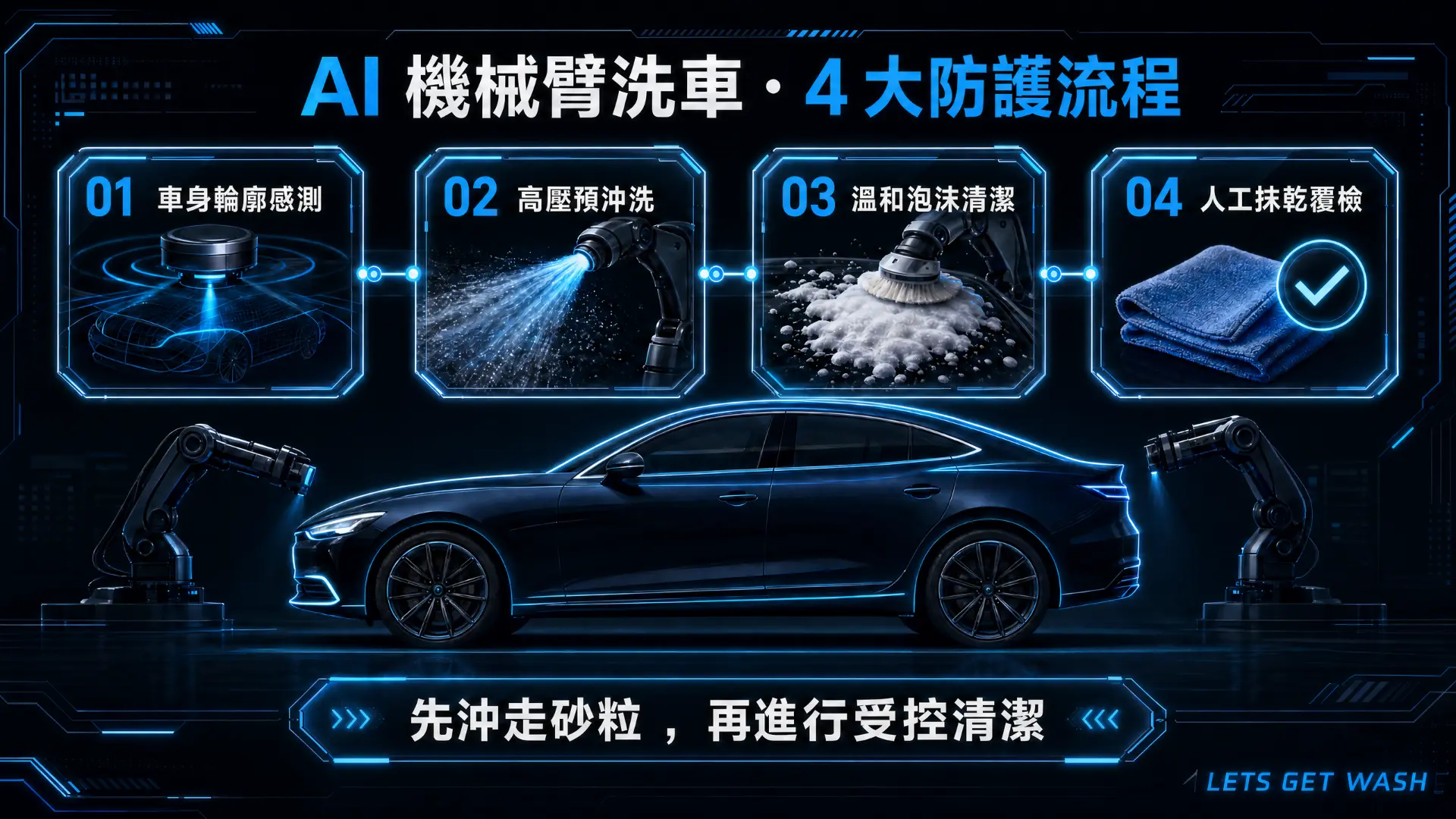 Four Protective Steps of AI Robotic Car Wash
Generally, robotic car washes can be broken down into four stages: 'vehicle identification, pre-decontamination, contour-based cleaning, and manual detailing'. 'AI' in different systems might refer to a combination of sensor data, rule-based control, vehicle parameters, path algorithms, or automated scheduling. For car owners, understanding the actual protective steps employed is more valuable than questioning whether the system is branded 'AI'.
1. Measuring Vehicle Contours: Establishing Safe Distance and Operating Path
The equipment uses sensors to read the vehicle's length, width, height, and surface contours, then moves nozzles, drying devices, or cleaning endpoints along corresponding distances. 3D sensing detects vehicle size and shape in real-time to precisely control the car wash mechanism; high-pressure systems can also adjust pressure and spray angle according to the contour.
However, contour recognition is not an 'invincible shield'. Modified wide-body kits, added roof racks, loose trim, exposed antennas, damaged wipers, open charging port covers, or untucked wing mirrors can all render the standard path unsuitable.
2. High-Pressure Pre-Rinse: Removing the Most Dangerous Grit First
The most common origin of fine lines on car paintwork isn't the robotic arm itself, but grit acting as an abrasive during the contact process. An ideal procedure first uses water jets to rinse off loose dust from the car surface from top to bottom, then focuses on areas particularly prone to accumulating dirt, such as wheel arches, sills, lower bumper edges, and door thresholds.
LETS GET WASH's AI Robot Hand Wash process begins with a high-pressure pre-rinse to remove road grit, followed by AI cleaning with pH-neutral shampoo, and separate treatment for wheels, tyres, and door jambs; after completion, it includes manual drying and glass cleaning.
3. Foam and Contact Cleaning: Making Friction Manageable
Ample foam helps soften dirt and increases lubrication between the cleaning endpoint and the paint surface, making it easier for residual fine particles to be carried away. If the service uses contact cleaning, three things truly need to be controlled: whether the contact tools are clean, whether the contact pressure is appropriate, and whether the tools transfer dirt from one area to another after passing over it.
4. Sectional Detailing and Manual Finishing: Covering Mechanical Blind Spots
Wheels, tyres, door jambs, areas around badges, fuel filler caps, license plate edges, and glass seals often require different tools and angles. Using the same set of wiping tools for wheel dirt and car paint is a common, often overlooked, source of cross-contamination. Manual drying is also the last opportunity to check the car body for any remaining grit, water spots, tree sap, bird droppings, or pre-existing fine lines.
Key Definition: "Swirl marks" are typically microscopic, circular abrasions accumulated on the clear coat of car paint, particularly noticeable under sunlight, car park spotlights, or when illuminated obliquely by a phone torch. They don't necessarily indicate severe damage from a single wash, but often reflect insufficient friction management over time.
3. Why Do Some Cars Still Have Fine Lines After Washing? The Real Risks Are In These Five Areas
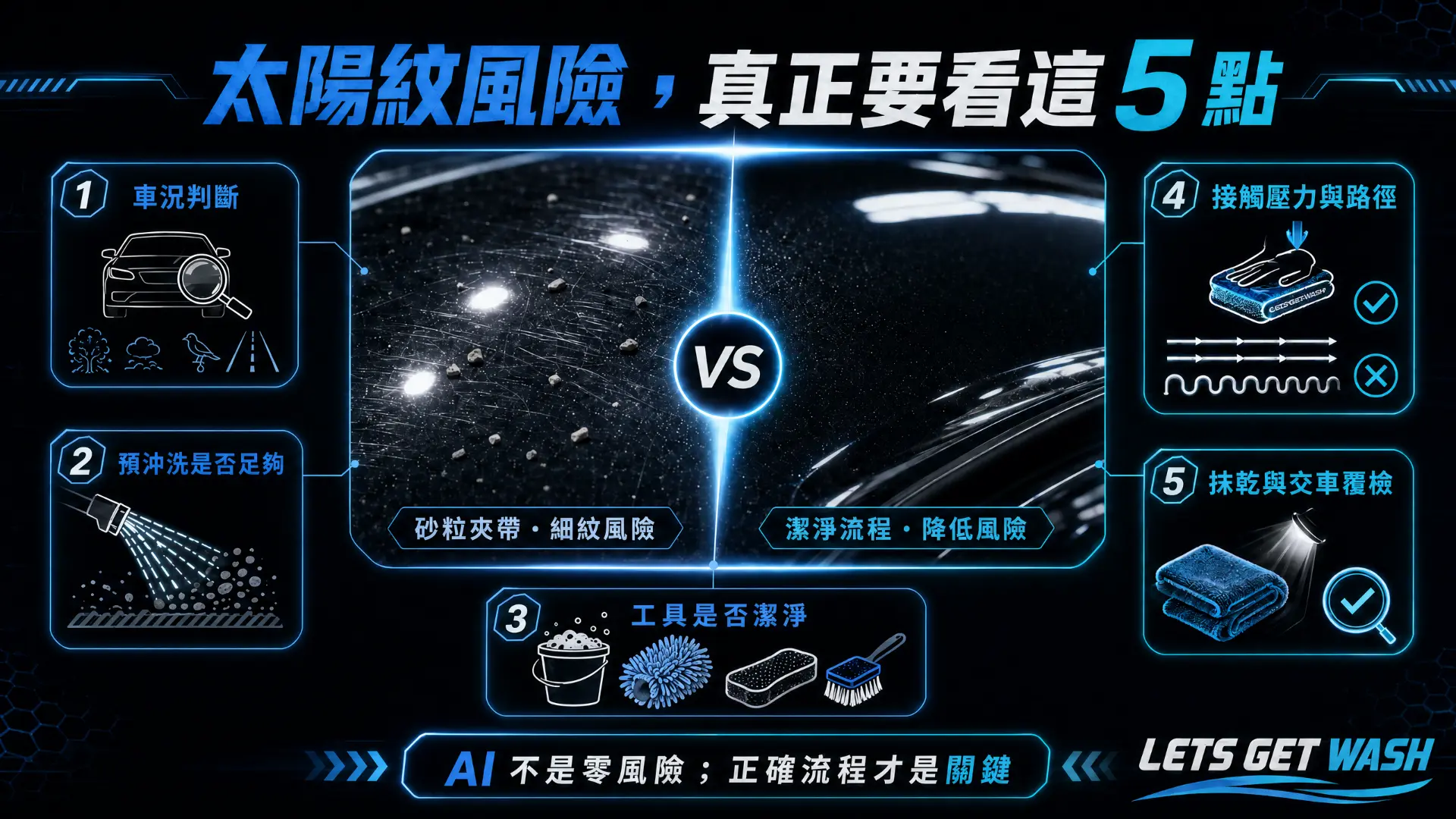 Five Key Swirl Mark Risks
| Risk Area | Common Problem | Potential Impact on Paintwork | Better Handling Method |
|---|---|---|---|
| Vehicle Condition Assessment | Treating a car after heavy rain, off-roading, or construction zones with a standard process | High amount of coarse grit, making it easier to create fine lines during contact | Inform staff about car condition, increase pre-wash and spot decontamination if necessary |
| Pre-Rinse | Only a quick rinse, without treating the lower body and wheel arches | Loose particles remain on the paintwork | Rinse from top to bottom, focusing on lower areas and crevices |
| Cleaning Medium | Sponges, brushes, or towels accumulating dirt | Hard particles repeatedly dragged across the surface | Use clean, purpose-specific tools, change immediately when dirty |
| Contact Pressure & Path | Excessive pressure, erratic back-and-forth motion, or repeated wiping of dry surfaces | Creates localised abrasions and circular fine lines | Use sufficient lubrication and consistent trajectories, avoid dry wiping |
| Drying & Handover | Using saturated or dropped towels directly on the car | Water spots, residual particles, or towel contamination causing new fine lines | Use clean microfibre towels to absorb water in sections, re-inspect under light before handover |
Among these, the term "touchless" is most easily misunderstood. A purely high-pressure, chemical-only touchless car wash can indeed reduce friction sources from contact; however, for stubborn dirt, water flow and chemical action alone may not be enough to remove it completely. Instead of just comparing 'with or without contact', it's more important to ask: Were contaminants removed before contact? Was there sufficient lubrication and clean tools during contact?
4. How Should AI Robotic Car Washes Be Compared to Traditional Manual Car Washes?
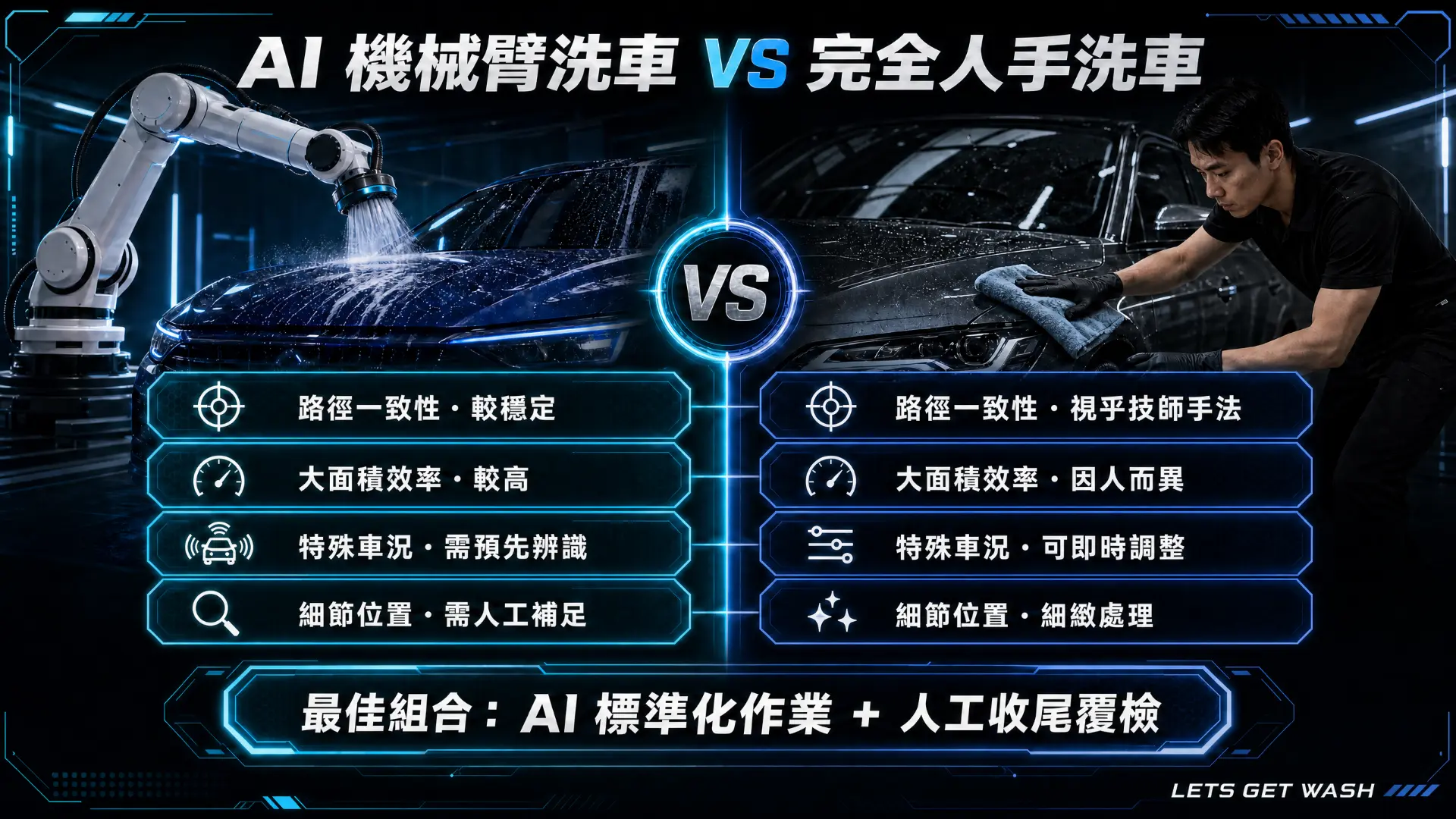 AI Robotic Car Wash VS Fully Manual Car Wash
| Comparison Aspect | AI Robotic Assisted Car Wash | Fully Manual Car Wash |
|---|---|---|
| Path Consistency | Can repeatedly execute similar trajectories based on system settings | Depends on technician's habits, fatigue, and daily workload |
| Large Area Efficiency | More stable, suitable for standardised rinsing and cleaning procedures | Speed varies greatly, may be inconsistent during busy periods |
| Special Vehicle Condition Response | Requires correct identification and pre-set exception procedures | Experienced technicians can make immediate judgments and adjustments |
| Detail Areas | May still require manual touch-ups | Can be handled meticulously, but depends on technician's standards |
| Key to Paint Safety | Sensing, pre-rinse, clean tools, manual inspection are all indispensable | Pre-rinse, clean tools, correct technique, manual inspection are equally indispensable |
What truly matters is whether the service provider is willing to clearly explain their process. If a shop can only say "we're very high-tech" but can't answer how pre-rinsing, wash solutions, tool segregation, unusual vehicle conditions, and handover inspections are handled, it may not be reassuring enough for those who care about their paintwork.
5. Six Things Car Owners Should Remember Before and After a Car Wash
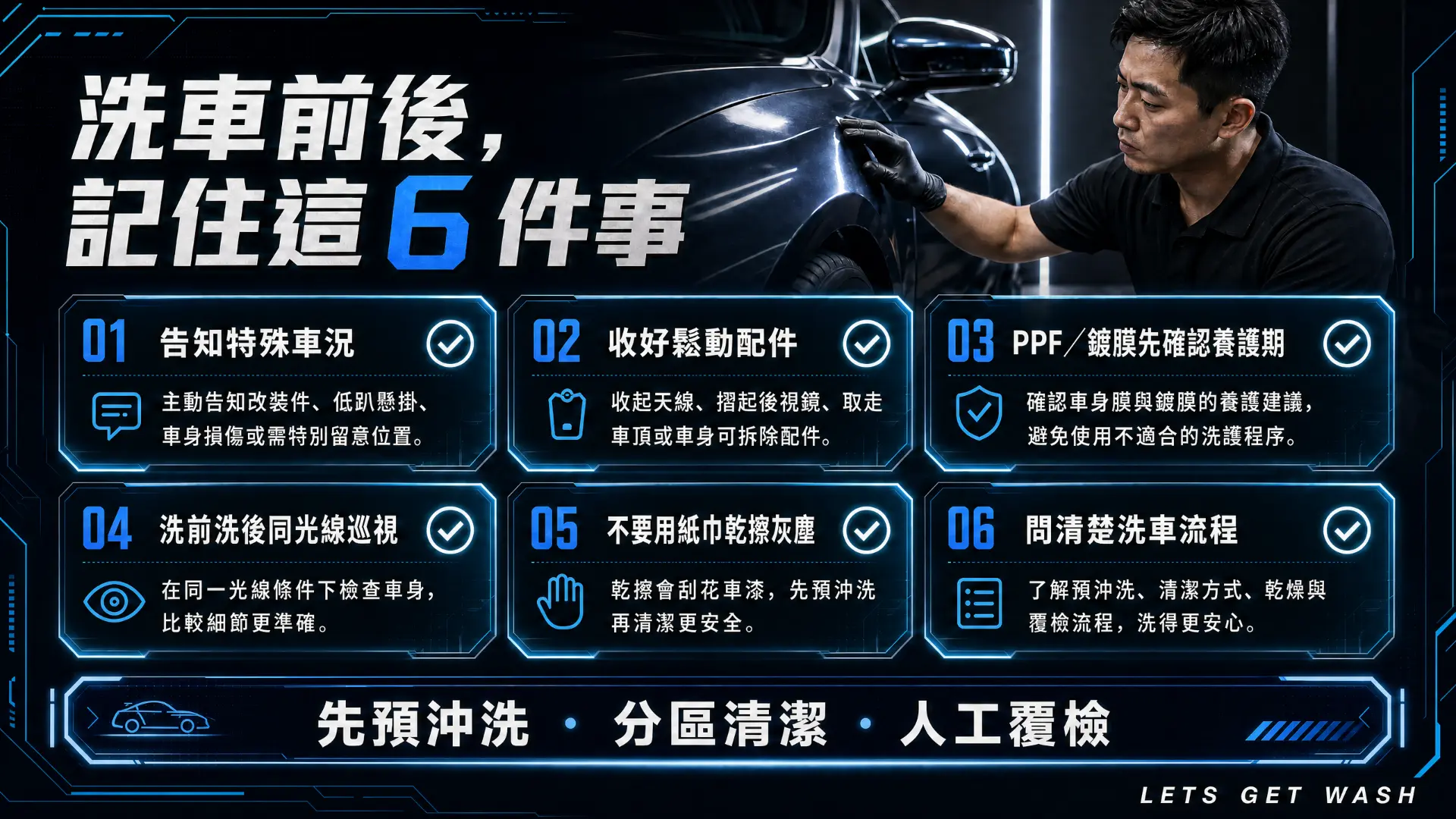 Car Wash Before & After Checklist: 6 Things
- Actively inform about special vehicle conditions: Mud, heavy rain, seaside, construction sites, or long-distance highway driving result in different types of dirt; tar, tree sap, bird droppings, metallic dust, paint overspray, or cement spots should be mentioned beforehand.
- Check exposed or loose accessories: Fold in electric wing mirrors, remove detachable antennas, roof rack accessories, and close charging port covers. Ensure wipers, trim, and license plate frames are not loose.
- For newly applied PPF, coatings, or fresh paint, confirm the curing period: PPF is an additional protective layer, but film edges, lifted areas, and curing periods should still follow the installer's recommendations.
- Inspect the car body under the same lighting before and after washing: Check the bonnet, roof, upper door sections, and black gloss trim under natural light or stable white light.
- Do not dry wipe dust or use paper towels on the car yourself: Dry wiping often drags particles across the clear coat more easily than a single, proper wash.
- Decide based on the service process, not just price or the word "AI": Is there a high-pressure pre-rinse? Are mild wash solutions used? Are wheels and body treated separately? Is there a final manual dry and inspection?
6. Which Car Owners Are Particularly Suited to Robotic Car Washes with Manual Finishing?
Cars with dark paintwork, extensive piano black trim, recently polished vehicles, new cars with PPF or coatings, and owners who require frequent car washes are typically better suited to services combining 'sensor-based robotic arms with manual finishing' – they demand stable, repeatable, and verifiable cleaning standards.
If the car body already has noticeable swirl marks, water spots, oxidation, tree sap etching, or faded old paint, a regular wash should not be expected to resolve these issues; such conditions may require assessment for decontamination, polishing, coating maintenance, or PPF services.
7. What to Do If You Suspect Scratches After a Car Wash?
The first step is not to repeatedly wipe a dry car body or use abrasive compounds yourself. First, observe under natural light and indoor lighting from different angles to distinguish between water spots, chemical residue, pre-existing fine lines, or genuinely new scratches. Take close-up and full-view photos to record the location, lighting, and time, and contact the service provider as soon as possible for joint inspection.
Second, assess the depth of the marks. If they are only shallow fine lines on the clear coat, professional detailing procedures may be able to improve them through appropriate polishing. If your fingernail can clearly catch the mark, exposing the base colour, or if the PPF is damaged, a professional should assess whether localised repair, re-application of film, or repainting is needed. The principle is always diagnosis first, then repair.
Frequently Asked Questions
Is an AI robotic car wash always safer than a manual car wash?
Not necessarily. Robotic arms can improve the consistency of trajectory and operational pace, but safety still depends on pre-rinsing, tool cleanliness, wash solution lubrication, pressure control, and manual inspection. A consistently high-quality hybrid process is usually more meaningful than simply comparing 'mechanical' or 'manual'.
Can AI car washes cause swirl marks?
As long as there is contact cleaning, there is theoretically a risk of micro-abrasions; however, this risk can be significantly reduced through thorough pre-washing, pH-neutral wash solutions, clean tools, appropriate pressure, and correct drying methods. The key cause of swirl marks is usually friction involving trapped grit.
Can I use an AI car wash if I have PPF?
Generally, yes, following the protection film installer's maintenance guidelines and using a mild, correct process is fine; however, for newly applied film, lifted edges, or existing damage, a professional should inspect it first.
Should I wash my car immediately after rain?
If the car body only has general rainwater and urban dust, you can schedule it according to your daily usage. However, if you've driven through mud, by the seaside, through construction sites, or flooded roads, it's more advisable to wash it promptly to prevent dirt and grit from remaining in wheel arches, the lower body, and crevices for too long.
What should I ask before booking?
First, understand the process and timing through the service page. Then, upon arrival, inform them of any special contaminants, modifications, or the status of PPF or coatings. If your car's condition is unusual, it's recommended to contact the team to confirm before booking.
Conclusion: The Point Isn't "Completely Touchless", But "Controlled Contact Every Time"
AI robotic car washes should neither be deified nor demonised. They can enhance consistency through sensing and standardised paths, making them particularly suitable for frequent, routine care. However, whether your paintwork remains gleaming ultimately depends on whether grit is removed first, whether appropriate wash solutions and clean tools are used, whether areas are treated separately, and whether professionals ensure the details are perfect at the final stage.
If your concern is "will an AI car wash scratch my car?", what's truly worth choosing isn't a slogan, but a process that can be explained, observed, and verified.